irag.
Give every coding agent the same second brain — and give yourself a command center for the entire project. irag remembers the whole codebase, proves its checkable claims against the real source, proves the live full-stack application instead of trusting silent wiring, audits the code, and turns live market evidence into grounded product thinking. Codex today, Claude tomorrow, Cursor after lunch — the project never forgets.
pip install git+https://github.com/Karang1908/irag.gitYour agent forgets. Your project does not have to.
Every coding agent ships the same fix for amnesia: a markdown file it re-reads at startup. Claims go stale, nobody notices, and the agent keeps trusting them. irag treats memory as a storage problem, not a prompt problem. Version every claim, fact-check it against the code mechanically, and let the expensive model read instead of re-explore.
It began as a database-systems assignment: a law-firm knowledge base, where a wrong court date is a real failure, not a bad chatbot answer. That discipline stuck when it was pointed at code. Read the full story.
| Graphify | claude-mem | irag | |
|---|---|---|---|
| Remembers | structure | conversations | structure + meaning + history |
| Can it be wrong? | rarely (it's a parse) | yes, silently, forever | yes, and it detects, records, and gates CI on it |
| Cost | free | scales with chat volume | reads free · writes on any cheap model |
irag's trade-offs, honestly: writes cost LLM calls (pluggable: point them at a free-quota model), it needs Python 3.11+, and the linter verifies checkable claims (paths, symbols, versions), not opinions. Full comparison →
One project brain. Every coding agent.
irag mcp is a real Model Context Protocol server, not a
Claude-specific adapter. Every client gets the same context, search, map,
impact, provenance, contradiction, update, lesson, decision, and session
tools — backed by the same SQLite file.
Switch tools without starting over. Run Codex and Claude in parallel without mixing their session history. Read operations never call a model; mutations share one repository lock so two agents cannot publish half an update.
codex mcp add irag -- irag mcp --root /absolute/project
claude mcp add --scope project irag -- irag mcp --root /absolute/project

✓ 22 tools · same memory · live evidence · isolated sessions
One machine remembers. One audits. One helps you decide what to build next.
Main Summary is the whole project on one living page. Not a vague executive abstract: every current file, folder, decision, and lesson in full, beside drift, contradictions, sessions, and audit state. Structural truth refreshes automatically, stale prose says that it is stale, and Memory Trust explains which evidence is lowering confidence instead of hiding it in a score.
Code Audit turns review risk into evidence. It maps APIs, finds dependency cycles, checks exact package versions against OSV, redacts suspected secrets, and attaches file, line, confidence, and remediation to every finding. The live API checker cannot wander beyond loopback or follow a redirect. Review decisions survive harmless line shifts, risk acceptances can expire, and open work exports as SARIF. Stale inventories fail closed.
App Proof catches the bugs that stay silent between layers. It traces frontend requests into discovered backend routes, then verifies the running application: reachable pages, internal and external links, forms, visible controls, safe API calls, optional Playwright behavior, and your project's real test suites.
Then it pressure-tests read-only loopback routes with bounded concurrency. There is no fake “all green”: each discovered check is passed, failed, blocked, untested, or excluded. A run becomes a durable HTML/JSON repair packet you can hand directly to any coding agent.
REPO   verified memory · current diff · latest audit
WEB    Brave / Tavily / SearXNG / DuckDuckGo · URL + retrieval time
MODES  code review · product · business · marketing · creative

→ sourced conversation + measured experiments + change-aware watchlists
Current trend claims require live sources. Search failure is disclosed. Repository text and web snippets are treated as untrusted data, never as instructions.
So your agent can look it up — for almost no tokens.
A node for every file, an edge for every import: one map your agent queries instead of re-reading your tree, instantly and for zero tokens.
Memory in. Work happens. Truth comes back.
reads · zero tokens
Your agent
Codex, Claude Code, Cursor, Windsurf, or the next tool: starts with the same ranked context through MCP. No fresh-chat amnesia.
the memory
irag
One SQLite file in your repo. Versions every page, logs isolated sessions, fact-checks checkable claims, and remembers renames. Reads call no model.
writes · cheap quota
The scribe
Any LLM CLI you configure writes the summaries, on a free-quota model, so bookkeeping never touches your agent's limits.
This is infrastructure, not another prompt file.
One MCP brain for every agent
Twenty-two standard tools. The same names, schemas, results, lock, and database in Codex, Claude, Cursor, Windsurf, VS Code, and any MCP client.
Full-stack proof, not frontend/backend hope
One run connects static contracts to live HTTP, browser controls, real test suites, and bounded stress—then keeps every unknown visible and produces the repair brief.
Your agent never greps again
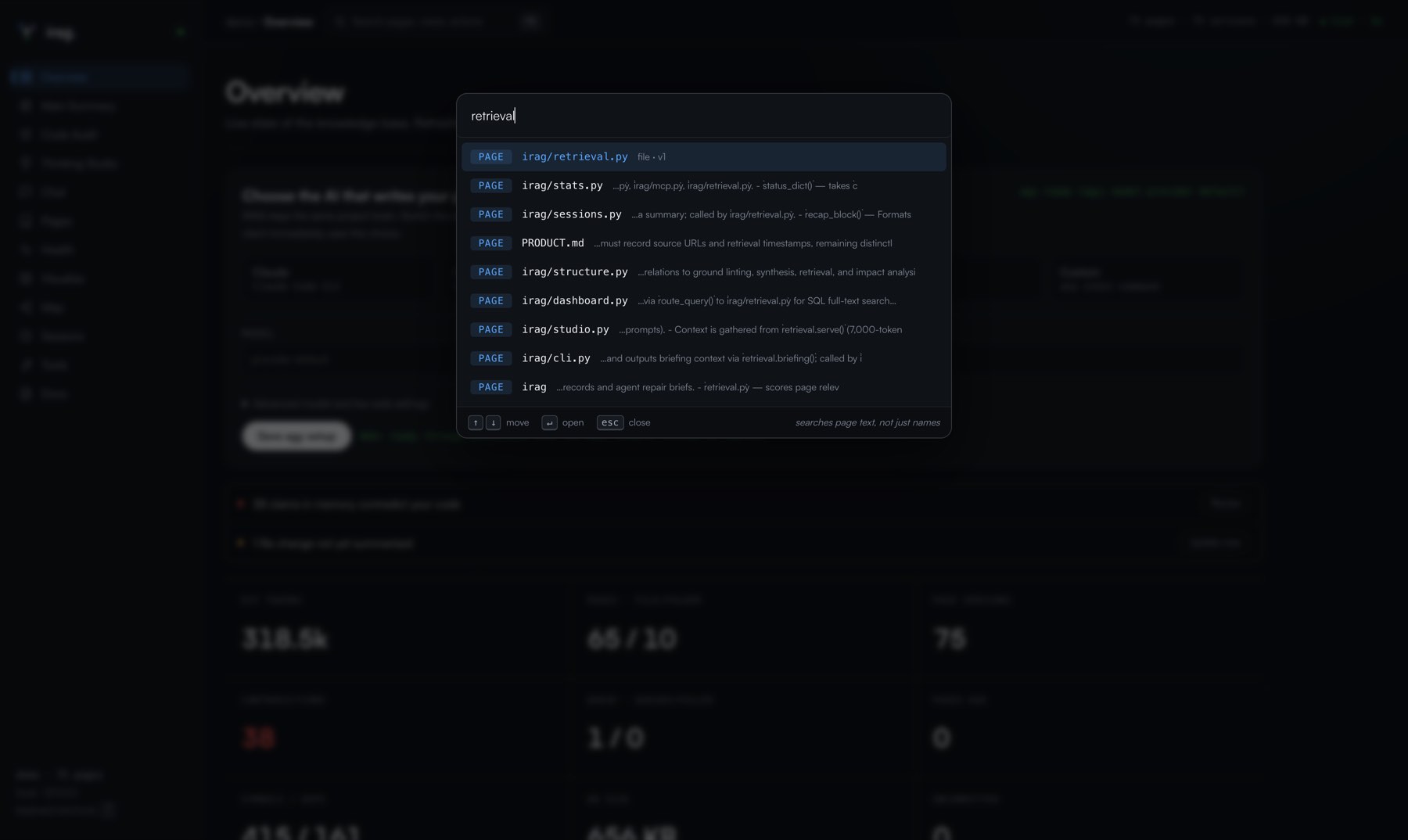
Search, code map, blast radius, and context come from SQL, not from the model re-reading your tree.
Contradictions arrive ready to fix
Open one issue or a master HTML repair packet: claim, truth, source-grounded context, and a complete prompt you can hand straight to a coding agent.
Choose the cheapest writer
Explicit adapters for Claude, Codex, agy, Ollama, and custom CLIs normalize retries and output while recording model, latency, tokens, and optional cost.
Upgrades that respect the only copy of your memory
Ordered migrations create an automatic backup first, record their history, and refuse a downgrade instead of gambling with newer data.
Large repositories stop paying the full-scan tax
Content edits reparse only changed source files. Topology changes stay conservative, and renames keep their complete revision lineage.
Live updates that survive the tab
Every dashboard run has a durable job ID, SQLite-backed progress, and an SSE stream that reconnects after refresh instead of losing the operation.
Every chat resumes where the last ended
Isolated session diaries retain changed behavior, decisions, invariants, failures, validation, and the exact per-file revision trail.
Live trends without pretending the model is current
Every external result keeps its URL and retrieval time. Search failure stays visible, and current claims never quietly fall back to model memory.
A complete summary that refuses to summarize things away
Every live memory page appears in full beside drift, audit, contradictions, and sessions — searchable, filterable, continuously refreshed, and scored by an explained evidence-based Memory Trust signal.
From diff to defensible release
Delivery maps contract removals, blast radius, related tests, native checks, and release gates into one brief a person or coding agent can execute.
Team memory without leaking the repository
Reviewable, idempotent bundles carry decisions, lessons, experiments, watchlists, topics, and audit triage—not code, transcripts, prompts, or commands.
Measured, not claimed.
Run on irag's own source. The read path costs nothing because nothing on it calls a model, which is a property of the architecture rather than a benchmark you have to trust.
One command runs the whole lifecycle end-to-end: ingest, synthesize, fact-check, CI gate, rollback, sessions, dashboard API, multi-language graph. The mock model in the suite deliberately hallucinates a missing file, so the fact-checker is proven to catch it rather than assumed to.
See what it knows.
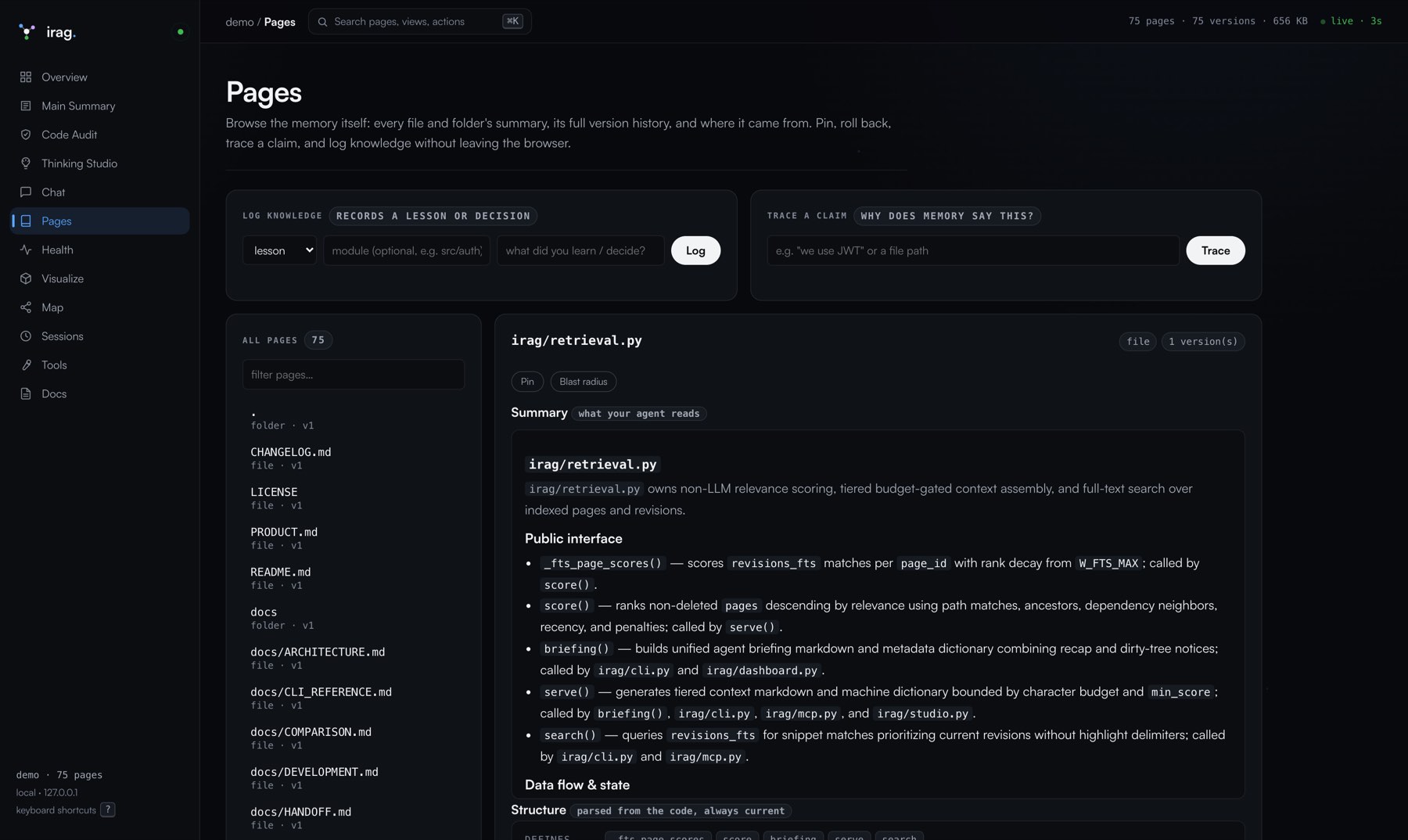
irag dashboard is a local, zero-dependency web UI
— and a full peer of the CLI, not a read-only viewer. Browse every page and
diff its history, roll one back, trace a claim to the commit that created it, read
a past conversation verbatim, preview the exact briefing your agent receives,
and run every maintenance operation. App Proof adds a complete runtime lab for
contracts, pages, links, controls, APIs, browser journeys, tests, and stress.
"A database system with an AI layer — not an AI system with a database attached."the design rule every table follows · read the story
Give your agent a memory.
pip install git+https://github.com/Karang1908/irag.git